
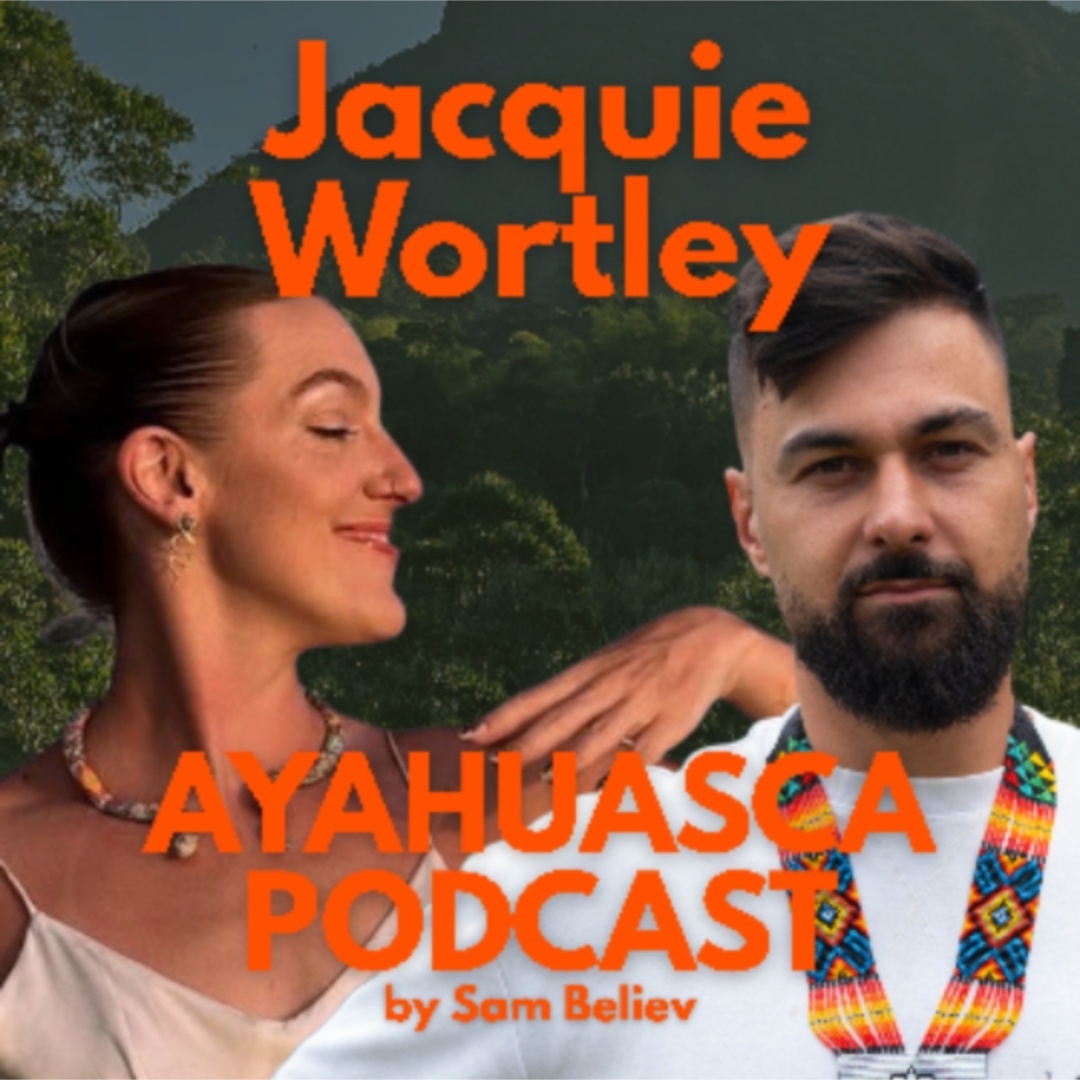
In this episode of the Ayahuasca Podcast, host Sam Believ sits down with Jacquie Wortley, a design leader, executive coach, and operations consultant who specializes in the intersection of technology, leadership, and mental health. Jacquie originally came to Lawayra in 2023 for what was supposed to be a simple weekend stay. Instead, she stayed for 10 days, sat with the medicine six times, and completely catalyzed her path away from emotional suppression, toxic relationship cycles, and excessive substance use.
Jacquie returns to share how her integration has evolved over the years, the profound lessons she learned from navigating a romantic relationship post-ceremony in July 2025, and how she is redefining corporate culture by introducing radical authenticity and soft skills to modern business environments.
Key Discussion Points
- 03:15 – The Runaway Nomad: Jacquie shares her journey from Vancouver to Toronto, building a successful tech career while using geographical changes and excessive partying to run from family turbulence and emotional pain.
- 07:45 – Sending a Scout: How testing the waters by sending a close friend to Lawayra first eventually led Jacquie to book her own transformative, 10-day marathon with the medicine.
- 11:20 – Shift in Substances: Outgrowing the “excessive user” label, eliminating stimulant drugs entirely, and shifting her relationship with alcohol away from a coping mechanism.
- 16:40 – Don’t Wake a Sleeping Baby: Jacquie opens up about her past mistake of trying to force psychedelic healing onto her previous partner before he was ready, and what it taught her about patience, humility, and unconditional love.
- 23:15 – The Illusion of Being “Chill”: A deep look into the paradox of control issues, why the people who need to surrender the most fight the medicine the hardest, and Sam’s story of a breakthrough moment over a mattress arrangement.
- 29:10 – The Conscious Operator: Stepping away from the traditional corporate “COO” mask to focus on deep inner self-awareness as the ultimate foundation for managing people and business logistics.
- 35:00 – Radical Responsibility at Work: How leaders can handle difficult interpersonal dynamics with transparency, drop the professional facade, and own their emotional capacity with their teams.
- 41:30 – Brainstorming the Entrepreneur Mastermind: Sam and Jacquie dive into a spontaneous idea to co-create a specialized Lawayra retreat tailored specifically for business owners, founders, and managers to combine ceremony with peer masterminds.
- 46:15 – Unmasking Safely: How to navigate corporate vulnerability, identifying who you can safely open up to at work, and introducing feminine leadership into masculine environments.
The Mechanics of Control and Surrender
A central theme of Jacquie and Sam’s dialogue centers around how trauma survivors often use hyper-vigilance and control as a shield. Ayahuasca systematically deconstructs this defense mechanism, teaching that true surrender is an internal energetic release rather than an intellectual concept. As Jacquie notes, the medicine teaches you in the most frustrating way that head-in-the-bucket submission is often required before you can truly connect.
The Reality of Relational Integration
Jacquie reflects deeply on her experience dating her partner again after his first retreat in July 2025. She points out a crucial lesson for anyone navigating relationships post-ceremony:
“The ceremonies are simply just a vision of what could be. But it’s our integration that makes that vision into reality. Integration happens through conscious choice making and behavioral changes in our day-to-day life.”
Expecting a first-time sitter to integrate at the exact pace of a seasoned practitioner is a form of projection. True unconditional love means releasing control and allowing others to be exactly who they are on their own path.
Connect with Jacquie Wortley:
- LinkedIn: Jacquie Wortley
- Instagram: @jacquiewortley
Join the Conscious Leader Movement: If the idea of an exclusive mastermind retreat for entrepreneurs, managers, and business operators resonates with you, let us know! Drop a comment on Spotify, YouTube, or reach out directly via Instagram to Sam or Jacquie.
To book a traditional retreat focused on deep inner awareness, visit: ayahuascaincolombia.com
If you appreciated this raw look into integration and leadership, please rate the show 5 stars!
Transcript
Jacquie Wortley: What was supposed to just be a weekend retreat ended up being a 10-day retreat where I sat six times for my first round with the medicine, and it completely changed my life in so many ways. One of the things that I always share with people who are curious about sitting with medicine, as I say, make sure you’re ready for things to be different in your life because you’re gonna feel very compelled to make changes.
It’s so hard, and you don’t connect with the medicine if you can’t let go. That’s what’s so funny about Ayahuasca. The people that need the medicine the most are the ones that have control issues. The ones that have control issues have the hardest time connecting to the medicine, and she really teaches you in the most frustrating way that surrender is required.
When you don’t share your message, when you don’t share your voice, you’re robbing the world of the gifts that you’ve been given. Entrepreneurship is not for everybody. Just like Ayahuasca is a calling, entrepreneurship should also be a calling. Let the call come from the inside, not the outside.
Sam Believ: You’re listening to AyahuascaPodcast.com.
Hi guys, and welcome to Ayahuasca Podcast. As always, we are the host, Sam Beliaev, and today I’m having a conversation with Jackie Wortley. Jackie is a design leader, coach, and a consultant who specializes in the intersection of tech, mental health. And Jackie came to La Wayra in 2023, and then a lot of cool things happened in her life.
So I wanna explore this and so much more. This episode is sponsored by La Wayra Ayahuasca Retreat. At La Wayra, we combine affordability, accessibility, and authenticity. La Wayra, connect, heal, grow. Guys, I’m looking forward to hosting you. Jackie, welcome to the show.
Jacquie Wortley: Thank you for having me. It’s been a long time coming.
Sam Believ: Yeah. I should have thought about it earlier. I don’t know why I never did because your journey is very interesting. You’re one of those cookie cutter examples of “Ayahuasca is good for you.” Now, I have people that come and they come back a year later, it’s like, “Yeah, I stopped drinking and I ran a marathon, and I started a business and I wrote a book.”
And it’s you had a somewhat similar journey in which Ayahuasca was a catalyst for all those things to happen. Because it was not just Ayahuasca, you did the work. But before we get there, let’s start with your journey. Tell us a little bit about yourself and what brought you to Ayahuasca.
Jacquie Wortley: Yeah. So originally I’m from Vancouver, Canada. I’ve been obsessed with travel my whole life. I lived in Australia, I was a tour guide in Asia and I came back to Canada from being abroad for a while in 2016, where I was coming face to face with a lot of difficulties in my family and that I’d been running from for a very long time.
I ended up moving from Vancouver to Toronto to, again, run away from these familial problems. Ended up finding a very fulfilling career in the technology space and unfortunately also ended up in a relationship that was deeply unhealthy and caused a lot of trauma and pain in my life. When that relationship ended, I decided I wanted to become a digital nomad.
COVID had other plans. It delayed me for a while, and I was actually meant to be spending the majority of my time in Asia, but I ended up in South America instead. And my first time in Colombia was in 2021, and I fell in love with the country and the culture, and I just continued to return year after year.
And on a visit in 2023, I actually had invited a close friend of mine out to visit me who was going through a hard time. And I’d never sat Ayahuasca before, but when she shared with me some of the challenges she was going through, I said, “Oh, you’re in South America. Maybe you should consider sitting with Ayahuasca.”
And she ended up finding LaWayra, went for a retreat, and shortly after she came back, I decided to go for myself. I knew I was ready. The calling came. And what was supposed to just be a weekend retreat ended up being a, a 10-day retreat where I sat six times for my first round with the medicine and- It completely changed my life in so many ways, and I actually went on to, work with Sam a little bit and seeing some ways I could use my business skills to help LaWayra grow because I really believed in giving people more access to the medicine and everything that LaWayra was doing.
And medicine has continued to be a really big part of my life. I’ve returned to LaWayra. I’ve been to other retreats. I’ve worked with other medicines now, but it was really those first sits when I came with you, Sam, when also you were still facilitating that really were the catalyst to huge changes in my life
Sam Believ: Yeah.
Back in the day. That was a long time ago. It’s very smart of you, to send an envoy, send someone to test the medicine first, and then you’re like, “Okay, that’s good. I’m gonna go and walk-” “… first morning.” Then, yeah, Med- Medellin does tend to be very addictive. S- I have a similar story. I came here once, and then I wanted to come again, and then I ended up living here now.
Tell us about that journey. Obviously your previous life, you were… You had some addictions, as, I believe, and em- emotional turbulence. Tell us about that, and then, like, how was that change? Because people, you like to talk about the fact that ayahuasca is not that magic medicine.
Of course if someone just listened to the first four minutes of this interview, it’s like, ”
Jacquie Wortley: Okay,
Sam Believ: I’m gonna go drink ayahuasca, and it’s gonna take all my problems away.” Let’s educate people, like your j- your journey.
Jacquie Wortley: Yeah ayahuasca is not a silver bullet. I had a challenging upbringing emotionally.
I think from the outside, nobody would’ve assumed it, because I grew up very financially privileged and stable. I had two parents who definitely loved me very much, but there was issues in the house growing up with emotional availability challenges around alcohol, turbulence between my brother and my mom.
My dad was away a lot on business in different continents. And I was that person in my house that was there, not really part of the problems, but often, especially as a child, like a victim of a circumstance that was not really mine, and it caused me to become a extremely depressed and anxious adult.
And throughout my 20s, I drank a lot of alcohol. I would probably drink seven days a week, party aggressively on the weekends. I was using stimulant drugs like MDMA and cocaine. And I think it was something that I excused a lot, because I would say I was not an addict, but an excessive user. And I think especially when you are living in cities like Toronto and New York, and all your friends are partying too, you tend to normalize it.
And I think as well the partying became a really easy and fun coping mechanism for a lot of the things that I went through. I mentioned briefly in the introduction that I ended up in a very unhealthy, abusive, toxic relationship when I was living in Toronto. And this partner and I drank a lot together and, you know- exhibited really destructive behaviors with one another.
And once that relationship ended, obviously I knew all those things were wrong. I had been mistreated. I was not okay with the way I showed up in that relationship, and I never really did anything about it. I knew it was wrong and it was bad, and I never wanted to encounter it again, but I had never really dug into the root of what was going on.
And those first sits that I had with the medicine back in spring of 2023 started to dive into, Me really having never truly expressed or even looked at the pain, the anger, and the hate that I had in my body that I just refused to look at for a long time. And as I began to come out the other end of at least those early ceremonies, I knew one of the best, easiest, and most obvious answers for me was to change my relationship with substances.
So after those initial sits, I completely stopped taking any type of stimulant drugs. I actually ended up avoiding places and situations that they would be around me, and I think this is one of the things that I always share with people who are curious about sitting with medicine, as I say make sure you’re ready for things to be different in your life because you’re gonna feel very compelled to make changes.
Now, if you make them, that is up to you, but I think especially when you’re fresh out of retreats, you feel a pull of, “Okay, I actually wanna do something about this.” In terms of my relationship with alcohol, that took a lot longer to change. I not fully went back into my old habits, but I was still drinking, I would say, for another solid year after that, and then I had
The more I sat with medicine the less inclined I was to drink alcohol to the point where now I very occasionally drink alcohol. I definitely have no more excessive use. I determined for me it wasn’t necessary to go completely sober. But certainly the role alcohol played in my life has totally changed, and now alcohol is not something that I reach for when I’m in a sad state or lonely or challenged.
It is just purely something that I enjoy with dinner or maybe one drink on a night out. So it’s like my experiences with Ayahuasca just changed the way I see alcohol’s role in my life. But I will be frank, that wasn’t easy because I think as often people learn after they sit with medicine, some of these changes that they wanna make, the other people in their life are not gonna understand why you wanna make those changes.
One of the things that I encountered and had to navigate was making sure that the loved ones in my life understood that m- my choice to not partake in these things anymore was not a reflection of them or their decisions at all. But this is something that can become really present as you make changes and shifts in your life after working with medicine that people around you are not gonna understand, and I believe part of the integration process is letting them misunderstand you
Sam Believ: Oh, thank you for sharing.
And first of all, congratulations. Yeah, it was not an easy journey, but you made it and I think it’s great. It’s great to hear. And I like that, you went not to oh now I’m not drinking at all, and to be like, “Okay, I can have one drink,” and that’s fine. ‘Cause that’s kinda my own understanding of addiction is like full just kinda zero alcohol or zero whatever, and if you engage in it, you fall back in again.
Then it’s like you’re kinda still addicted and you just… I think that the full, the true proof of not having addiction is being able to engage with the substance or behavior a little bit and not fall into the the old patterns, I think. But obviously it’s not recommended for people that are… certain things are just like heroin, I would assume, or fentanyl.
But I’m talking about like socially acceptable addictions. But what you’re saying is right, it’s like it’s really important when you go back and you’re this new person and you’re exploring, there will be people that will absolutely want to bring you back with them. So it’s when someone in your life is changing and they’re becoming better, you have two choices.
You go with them up or you drag them down, and it’s much easier to drag them down. And I love that not only you change yourself, but I know eventually your ex-partner, you also pulled him into the healing. So talk to us about that journey, Ayahuasca and relationships.
…
Sam Believ: ‘Cause yeah, it’s a hot topic
Jacquie Wortley: I’ve learned so much, Sam.
I did so many things wrong. One of the best ways that s- one of my teachers described this process to me is that The spiritual awakening is like, It’s imagine there’s a sleeping, there’s a sleeping baby, and that sleeping baby is your partner, your brother, your best friend, and you’ve just woken up, and then you see them and you’re like, I want them to wake up, too.
I want them to wake up, too. I’m gonna go wake them up.” But you have multiple children, you understand. You don’t wake a sleeping baby. When you wake a sleeping baby, the baby is pissed. The baby does not wanna be woken up. We need to let babies wake up on their own, no matter how much we wanna see them.
And we wanna see them, be in this world with us. And the mistake that I made with my previous partner was I woke up the baby and tried to push and force medicine use when he wasn’t yet called, and it caused a lot of rift in our relationship. It caused a lot of disconnect. And I think I’ve really been able to now, full circle, see that it’s really important that when we have a loved one in our life that we desire to sit with medicine, that we learn to have the patience and humility to let them get there in their own time.
And if this is not something that they’re ready for or something they’re not called to, it is our choice, our responsibility, and our decision to step away from that relationship if this is something that we feel is not aligned for us anymore, and I learned this the hard way. So this partner and I did eventually end up sitting medicine together in July of this year, so July 2025.
And in the retreat and post I met this version of him that I always knew was there. I was like, “Oh, there he is.” And after this retreat, he came to me and said, you know- “Let’s do it. Let’s date again.” We were broken up at that point, and I was really excited. This had been like the moment I was waiting for.
I experienced this version of him on retreat while he’s fresh with the medicine and I’m fresh with the medicine, and everything’s perfect and we’re so in love, and we’re gonna work it out, and it’s great. But the thing I very often say to people about medicine and working with Ayahuasca, at least in my experience, is that the ceremonies are simply just a vision of what could be, but it’s our integration that makes that vision into reality, and integration happens through conscious choice-making and behavioral changes in our day-to-day life.
So ultimately, when we left ceremony, we gave it a go and we were dating again, but once we were pressed back into the real world, especially because, these were his first experiences with the medicine. At this point, I’ve sat over 15 times with the medicine, which in medicine standards is not a lot, but comparatively to someone who’s never sat before it’s a really big difference.
And so I knew what to expect in the integration process, right? You leave retreat and you know you go back to real life, and this is where the work really begins. And I think I expected him to integrate in the same way I do, which also was me projecting massively and just wanting my needs to be met, and not being patient and not being loving and not being kind.
And unfortunately, the integration for him of this person that I met at the retreat didn’t materialize fast enough in order for us to be able to progress the romantic relationship All this to say, we have a great relationship now, not a romantic one, but as friends and professional collaborators.
Life is a mystery, who knows? But this is where we’ve ended up landing. That makes sense for us because something I did learn with medicine is I wanna live my life from a state of unconditional love, and the most loving thing that I can do with this person is love them for exactly who they are, exactly where they’re at.
Love them for their choices, even if that choice is not being in a ro- romantic relationship with me. And I think that can be one of the hardest things to accept, but one of the greatest lessons that medicine has taught me is I get to release control. I get to be on my own path and allow others to be on theirs, too
Sam Believ: Let’s talk about control-
And specifically how that affects, control and the medicine, because it can be challenging for people with traumatic childhoods that seek control-
…
Sam Believ: To let go of it in the ceremony. You wanna talk about that a little bit?
Jacquie Wortley: Yeah. It’s so hard. It’s so hard, and you don’t connect with the medicine if you can’t let go.
That’s what’s so funny. It’s funny about Ayahuasca. The people that need the medicine the most are the ones that have control issues. The ones that have control issues have the hardest time connecting to the medicine, and she really teaches you in the most frustrating way that surrender is required.
It was a ceremony that I had in January of 2025 that I finally experienced true surrender. I literally was on my hands and knees, and obviously I’m talking in my head while this is happening out loud, but I have my hand in the air, I’m like, “Fine, I surrender. Fine. Fine.” And something just clicked and it changed, because I genuinely was letting go.
I wasn’t being like, “I release control,” “I’m letting go.” It’s like, no, I’m literally like, head in the bucket, “Okay, fine, I let go.” And I think ceremony taught me I could do it. Now, when it came to life, I will tell you that integration is a constant journey for me, but it has taken me over a year. In fact very recently have I been able to practice releasing control in my life actively, like in the last month.
It’s taken almost a year for that one to really sink in.
Sam Believ: Yeah. Ayahuasca can definitely do it for you. It can really beat you up into submission. So it’s a question of when.
But the control issues are very interesting. I definitely like to control things in my life.
This is my trauma response. But with the medicine I’ve learned to let go. But we’ve had a person once, and she was… She just couldn’t connect, and I asked her like, “Do you have control issues? Do you have problems with control?” She’s like no, I’m so chill. I’m so relaxed.” I’m like, “Tell me your process of choosing a mattress in a ceremony space.”
She’s like I need to take this so it’s not too close to this, but it’s far from that.” And it’s it’s like you had… It was elaborate process and as she was saying this, it was like, she’s it hit her. “Yes I’m a control freak. I have issues with that.” It’s… A lot of times we don’t know we have that.
It kinda takes a certain level of introspection to get there. I definitely would never known if I, if not for Ayahuasca, ’cause I think “I’m so chill, I’m so aloof.” But, we all have the, we all have, have those things. Let’s talk about business. You like- … talking about business. And, for a period of time you were helping us here at LaWayra, and you came and you were the first person to ever try to do an org map of this mess, and it was very interesting. Before that, let’s talk about what is conscious entrepreneurship, and why does every business need a conscious operator?
Jacquie Wortley: I think our work with Ayahuasca, we’re becoming the conscious operators of our own lives, right? We’re becoming aware, going through individuation and understanding ourselves, our patterns, why we do the things we do. That’s the process of becoming conscious. It’s deep inner awareness. And then when we have inner awareness, we can have more effective outer awareness, and I think that’s where it can come into our business, right?
Because- When we become aware of ourselves, we can now tap into becoming aware of our people. We can start asking them the questions that maybe they haven’t been asked before. We can ask ourselves the questions that we haven’t been asking ourselves before. And to me, operations is not just tasks and things to do.
It’s funny because I’m finding myself transitioning away from this title of a COO because I think it actually undervalues what a conscious operation is. It’s looking at our entire business way zoomed out and saying, “Okay, how do these things connect? Is that person happy? Do I need to fire somebody?
How do I feel about that? Do I have the capacity to even communicate that compassionately? Am I ready to make a hard decision?” These are the things I think we, we shy away from often because it’s uncomfortable. But I think, and I’m sure you would agree with this, Sam, Ayahuasca is a great way to learn about yourself, but I think being an entrepreneur is arguably even harder because it’s right in your face every single day.
Your patterns show up in the way you run your business every day, and that is where I believe conscious operations is different because it’s thinking about how we grow businesses from a lens of deep inner self-awareness and how we as leaders show up in the businesses we create and the work that we do
Sam Believ: Yeah, it’s very interesting because it’s l- that’s a different kind of conscious entrepreneurship I wanna talk about, but let’s go there as well because with this with the business, and it took me a long time to realize, is that because I have created it and because I put my energy into it we’re connected.
And if I am in a certain low vibrational state, it will affect the business in general, and sometimes you can almost if you have a negative outlook, you can almost manifest negative things happening. I don’t know if you wanna talk about this. It’s definitely not the angle I was thinking about, but any thoughts?
Jacquie Wortley: Yeah, this is really what I mean by it, and I’m happy to go into the discussion more about probably what you’re thinking ’cause that is how I… I think just to lay it out on the table, I think when people think about conscious entrepreneurship, they’re thinking about people that are running businesses that are good for humanity, good for the planet, right?
But the thing is, I believe conscious entrepreneurship, you could be manufacturing plates and be a conscious entrepreneur because as you said, what’s happening in your life shows up in your leadership. And no matter how hard you try to put on the professional mask Energetically, people will feel you and they will feel you when you are not yourself and you are different.
The issue is in professional environments, we just all lie to each other. I think it’s probably the environment in our life where we are the most dishonest and the least self-honoring because, let’s take your romantic intimate relationship, for example. That’s usually the one where you’re on average the most honest and therefore experience the highest amount of conflict.
In professional environments, even the most anxious attached person becomes avoidant. People just don’t talk about things that are uncomfortable at work for fear of looking stupid or losing their job or not being respected by their team. But what I really wanna call in and really where I’m taking my work now is I wanna be able to teach and empower leaders to take off the mask, be uncomfortable, have the hard conversations that maybe you’ve been avoiding.
Tell your team, “Hey guys, I don’t wanna get into the details. I’m going through something personal right now. I’m gonna be showing up at 65% capacity, but I’m gonna give you the best 65 I can. And to account for this loss of 35% of my energy I’m hiring an extra assistant to help me at the moment.”
This is where we get to take radical responsibility and take the lessons that we have with plant medicine that we’ve been learning about ourselves and bring them into the professional context and be the leaders that the world desperately needs right now
Sam Believ: Yeah. People definitely… As you, as you speak about it, I’m having an idea.
I’m having a download. Just kidding. No, it’s just an idea. We should do a retreat for business owners or n- entrepreneurs.
Jacquie Wortley: It’s a huge dream of mine actually to do that, to have- That’s good … leaders come drink Ayahuasca and have, have peer conversations about the things that are hard. It’s funny, right?
Like right now I’m working with a client where I’m running a founder’s mediation, and teaching non-violent communication tactics to help them figure out how to move forward in the business without so much frustration and avoidance and dishonesty. And it’s uncomfortable, right? Just like how, you’ll sit I- sit with Ayahuasca, and then the next day we’re in a word circle, and people are sharing things that are uncomfortable.
But I think things get to be different if we decide we want them to be different. Just like how we do in our personal lives we get to show up differently at work as well.
Sam Believ: This episode is sponsored by LaWayra Ayahuasca Retreat. Most of LaWayra if you’ve been listening to this podcast for a while.
Some of you might have already been to LaWayra before. For those who don’t know us yet, we started LaWayra four years ago. At LaWayra, we combine authenticity, accessibility, and affordability. LaWayra is currently highest rated Ayahuasca retreat in South America, with more than 700 five-star reviews and an average rating of five stars.
If you come to LaWayra, you’ll experience powerful, authentic ceremonies led by our indigenous shaman, Fernando, in a very beautiful venue just one hour south of Medellín, Colombia. We’re surrounded by nature and have comforts like hot water, Wi-Fi. At LaWayra, our team has guided more than 2,500 people through this life-changing transformation of Ayahuasca experience.
At the same time, we keep it very affordable. So whether you’re coming for healing, clarity, or a deeper connection to yourself, LaWayra is the best choice. If it is your first time drinking Ayahuasca, you will love our three and a half hour preparation course and integration support. All of that is included in price, as well as pickup from Medellín, accommodation and Ayahuasca.
Visit lawayra.com to book your retreat or learn more. LaWayra, connect, heal, grow. L-A-W-A-Y-R-A.com. How about we do a retreat for entrepreneurs, business owners, and managers and then instead of just word circle every time, there- one will be a word circle, we talk about yourself, and then there will be another one will be j- which is more of a mastermind, and then you can talk- about work and kinda get creativity from Ayahuasca to fix your businesses.
Jacquie Wortley: I love that idea. And the thing I’m learning in my work is that- Most business issues are communication and interpersonal issues.
Yeah. It’s all relational at the end of the day. Even something related to sales could have actually been a relational problem, because you could have a, a sales rep who was like your number one person, and now they’ve got things going on in their own life.
They’re not showing up well. They’re never gonna tell you that ’cause they’re your number one salesperson, and all of a sudden sales are going down and-
…
Jacquie Wortley: You’re like, “Why?” But nobody can talk about it, so then maybe you just fire them, and you get someone else who never would’ve been as good as them.
Maybe they just needed to be supported. Like-
…
Jacquie Wortley: Yeah it’s it’s been really cool to navigate. And funnily enough, I was just the other week at an AI conference. It was probably 85% men, and one of the interesting things that I’ve felt an inner calling towards is basically bringing feminine leadership approaches, more s- more soft skills to masculine business environments.
Because, I mean I think that the pressure that men face to show up as I have all my shit together at work, right? I think if a woman cries at work, it’s socially unacceptable but forgiven. If a man cries at work, how would people react? Is there even space for that?
Sam Believ: I can talk about myself, and at my work, men are allowed to cry.
Jacquie Wortley: Of course, you’re on Ayahuasca retreat and you’re a conscious entrepreneur.
Sam Believ: And I might have cried in the word circle a couple times myself. Yeah. And people seem to accept it, But yeah, it is definitely challenging. There’s a lot of we’ve been programmed to be a certain way. And recently, last few months of 2025 were really challenging for me ’cause I’m also going through similar thing you went through, which is are we together, are we not together?
And it’s been really challenging. I don’t… I have no idea what I would do without Ayahuasca ’cause I, you know, have Ayahuasca and it was great help. But yeah, I was not showing up. I had a conversation, one of the volunteers told my general manager that, they were expecting to see me and talk to me and I’m like, “I’m not there.”
And I’m like, “No, I’m normally always best buddies with my team, but I’m just not available ’cause I don’t have time.” So I had to talk to them and say “Yeah, I’m going through this stuff and it’s really challenging.” And I guess they- they underst- understanding came from it, but it was not like an immediate thing because you do first try to hide as much as you can.
But also in this space, and with Ayahuasca specifically, people will feel that you’re not okay. Let’s say patients or people that are drinking the medicine, if the team is not okay, they will feel. If there’s any dynamics they become extra super perceptive- … to that kind of stuff, so you can’t really hide anything.
And yeah. But if for those who are listening, if you just happen to be like the idea of a retreat like this, do comment- Yeah … both on Spotify and on YouTube. Those are the comments that I would see. Or just message me on Instagram. ‘Cause if it is a thing that people want I would love it myself.
‘Cause I’ll participate as just another business owner myself. I think it’s really cool. Yeah, let’s brainstorm this idea, Jackie, maybe after the the conversation. Do you have anything else you wanna talk about in that in this topic?
Jacquie Wortley: Yeah, I think it’s, maybe we could talk about I think it’d be cool to talk about How to know who you can open up to at work
Sam Believ: That’s a good, that’s a good one.
Let’s go there.
Jacquie Wortley: So something I’ve been exploring lately is, ’cause I get asked a lot, I’m really open about my experiences with plant medicine. I’m really open about the stories from my past, especially because I’m really not attached to them anymore, so I have a whole different lens. But, I have a lot of people asking me how did you do it?
How did you feel so comfortable to talk about it? How on earth did you tell your colleagues,” “that you went and sat Ayahuasca?” And I think it’s really dependent. So I think we can confidently say there are certain work environments where it’s probably not gonna be beneficial for you to, say, tell your boss, and I think you can feel it.
I think you can feel when you work with people that are judgmental, that are not understanding, that are not open-minded. But everybody has a friend at work, on average, right? And I think you can start, if you want to, if you’re feeling like, “I wanna let go of the mask, at least with this person,” you can just slowly start sharing, “Oh, like I’m going through an individuation process,” right?
“I’m starting to learn about myself.” And then if they’re interested, say, “Yeah actually this thing I’m experiencing, some people call it a spiritual awakening.” And then it’s just like you’re temperature checking every time. Okay, they accepted spiritual awakening. Now maybe I tell them actually I went and I did– I worked with, ancestral medicine in Colombia,” right?
“Oh, okay, that’s connecting. Have you heard of something called Ayahuasca?” I always begin with an assumption that they don’t know, and I think it’s a really important thing to make sure that you’re not coming at it of like a, “Oh, you haven’t heard of Ayahuasca?” If we wanna open the door for more people to feel comfortable asking about plant medicine or if you wanna share about your experiences, I always invite people to consider, “Am I making this a comfortable topic of discussion?”
I don’t want anybody to feel like I’m trying to push them to do something or make them. I also think it’s really important to in your own journey, be okay with people thinking you’re crazy. Like fi– you have to get to a point where you find it hilarious and fun that people think you’re crazy, because then at that point if you do experience judgment from them, it will not in any way impact you.
I also think in terms of talking about plant medicine in the workplace, just know where you are. I know in America there’s really strict laws around these things, and so it’s just about understanding the places and the environments that it’s acceptable and safe to talk about these things.
I’ve definitely talked a lot about my plant medicine experiences when I go to networking events or conferences where I’m just… I don’t know, somehow I just– I guess it’s like that joke, right? Like people that do Ayahuasca, they just always wanna talk about it. But when people ask me about my life story, it’s such a critical part of it, so I often find myself in conversations in professional environments talking about medicine.
And I think it’s just come from a place of I feel really comfortable talking about it, and so it invites people to feel comfortable asking questions about it.
Sam Believ: Yeah. I ma- I made a meme about it two years ago. It’s how to tell if someone drinks ayahuasca. They will tell you. They’ll tell
Jacquie Wortley: you.
Yeah. They’ll tell you.
Sam Believ: I, The spirits were for a few months, I was making bunch of memes on Instagram, and then our account got banned unfortunately. It’s, I remember that happened … it’s very challenging in this business. But yeah- … for people sharing about their ayahuasca experience, I always say have a few different sto- versions.
For some people it’s like, “I went to a retreat,” and for others you go deeper, and you will know who wants to know more. But it can be very challenging because w- I remember we had one lady and she worked in law enforcement or something like that where she- … absolutely couldn’t tell, but she had so much change and I was like, “What the hell did you do?
I want this as well.” And she was finding a hard time to finding lies for her coworkers because she could not explain the amount of change by our typical excuse, which is a yoga retreat. Yeah. So talking about challenges of the business. When you were consulting us here at LaWayra what do you think is what is different about running an ayahuasca retreat as opposed to other businesses you’ve been working with?
Jacquie Wortley: Like the, one of the most complicated by far. Yeah. Totally. And I did I did some preparatory consulting for another retreat as well, so actually having the insight I had working with LaWayra was valuable. I think the, the piece that is very different and complicated about running an ayahuasca retreat is the duty of care element.
Understanding that the patients are consenting to undergoing something that can be potentially psychologically painful or traumatizing for them. And I think that immense responsibility that’s being held underpins every other little thing that you’re considering, like getting people fed. Are the rooms clean?
Is ceremony space set up? Are the volunteers overworked? Do we have enough leadership? Does everybody know what to do? What happens if Taita has to go to the hospital, right? Like, all of these things- … come up. And I think that there’s so much that goes into running a retreat, period. But when we’re adding plant medicine on top of that experience, it is a whole ‘nother level.
And then you’re also you’re growing a business. This is not-for-profit. This is a business. But then I think you face a lot of opinions around pricing, and how much should it be or should it not be? And you want it to be accessible, but also it’s a business and you wanna grow it, right? And you can only grow it when there’s capital to then invest in all the projects you wanna do.
And I think what I learned in working with you is that there are infinite moving pieces inside this type of a business.
Sam Believ: Yeah, it’s like a hotel plus restaurant plus a psych ward plus a media company and, so many more all together. And the medicine itself is chaos.
And people’s emotions is chaos.
And it’s like, how do you make order in this chaos without removing the magic, it’s it’s this balancing act.
Jacquie Wortley: You hire a general manager, which I’m really glad ended up happening. That was the first step.
Sam Believ: Yeah. I think, too, maybe- I have some stories to tell you about this because a lot have changed since then, but maybe we’ll leave it for after the podcast.
It was, it was a challenging thing. But in, in short, my team, my business team is great now. I have- … I finally have a business team, and I’m finally n- not completely overworked, and I can even partake in the retreats and focus on my own healing. Which is really cool when you have your own Ayahuasca retreat.
It’s like, it’s amazing. But th- this topic about pricing, for example, right? At LaWayra, we have really affordable prices, and it’s not because we can’t charge more or we don’t deserve to charge more. It’s because I do really want it to be affordable for as many people as possible. But occasionally, I do have to increase the price, especially now when dollar just dropped 25% against peso in last year, and which means that all of a sudden we have 25% less money.
So I need to increase the price by 25% or I’ll go out of business. But it is very challenging because, yeah, there, there’s always criticism. And for me, it’s interesting because for each person that tells me, “Oh, your price is high,” I have three or four people saying “Oh, you should increase the price,” which is a good place to be in.
But, the, the challenges of balancing spirituality and entrepreneurship something I face every day. Because business in its nature is this sort of thing where you’re trying to… There’s a bit of energy of holding towards something because you need to keep the money. ‘Cause if you’re in the business and you’re like, “Oh, no, let’s let’s pay this person triple the wage” just because you’re generous, your business is gonna fall apart.
So it’s that balance is very challenging for me, and I can’t really be both in, in like numbers space and the spiritual space. … So I oscillate between one and another. Do you have any advice there or any, any observations from other conscious businesses?
Jacquie Wortley: Yeah. It’s the one that I get asked about the most, to be honest, and I wish I had a simple answer for you.
But I believe that as business owners and leaders, we have a duty to be able to oscillate between- our needs and the business needs, and sometimes what’s the best choice for our spirit in that moment is a really poor choice for the business. Or sometimes what’s really good for the business can hurt our spirit.
And that’s where I believe there’s an option, for example, to, We get to navigate difficult and hard situations, right? Like a price increase could feel difficult, but in the long run, right? I always like to remind my clients, let’s come back to the vision and let’s think big picture. So even to ask you, Sam, what is the vision for LaWayra?
What’s the mission of this business? Why are you doing it?
Sam Believ: To heal people, to give ayahuasca
Jacquie Wortley: to as many people as possible. Okay, you have to raise the prices 25%, but you said you have to do that to keep the business open. So okay, in that moment it’s gonna feel challenging in some ways to raise the price by 25%, because there m- that might disclude some people from coming.
But if it keeps the business open and running, then it’s still serving the mission and the vision of what you’ve created, right? And I think that’s something that we get to come back to, okay. Or you have somebody that, you know, initially when they were working with you it was great, and then the business shifted and changed, and now it’s not working anymore.
And- You’re becoming resentful of this person, but you’re not actually telling them how you feel. They feel you’re acting differently around them, and then they start feeling super insecure in the work that they’re doing. Or conversely, they just start checking out ’cause they can tell that you’re unhappy with them, but nobody’s saying anything.
And that’s not only bad for the business, it’s bad for your soul because you’re not speaking your truth. They are confused. The business is hurt from it. Actually, the most spiritual thing to do is what’s best for the business, because you’re gonna speak your truth and say, “Hey, I think we’re gonna, we’re gonna part ways now, and thank you for everything.”
And also, you know in making that choice, even though it’s gonna be hard in that moment, number one, you actually have a higher chance of preserving that relationship the sooner that you deal with the uncomfortable conversation. And number two, you’re gonna be able to then free up the space to bring in the right person that the business needs, again, to ex- make sure that the vision and the mission comes into fruition.
So I always invite leaders to really zoom out, and very often I’m observing with the clients I work with, it always comes back to, am I standing in my truth? Am I being authentic? Am I being honest?
Sam Believ: Yeah. Oh, definitely. It’s it’s doing the, there’s a lot of difficult things you need to do, and sometimes it’s not, it doesn’t feel spiritual, so we had to fire some people recently, also connected to the fact that yeah the economy of things. And and for me it was re- really difficult. And when I did it, people were like, “How can you fire people? This is a spiritual place. This is this is a retreat, and there’s all about love.” And I was like for me it’s a simple choice of firing five people now or firing everyone a few months from now if we don’t have the money,” right?
So it’s, But yeah, it, you do have unrealistic expectations as in this space specifically where you can somehow work for free and then pay everyone and have everyone happy. So there’s a bit of it’s definitely… I believe it’s difficult in every business, but this one has specifically high expectations, on the founder and entrepreneur.
But I don’t know if you wanna talk about this and also talk about how difficult entrepreneurship is and that maybe, it’s unfair that society expects everyone to be an entrepreneur now. There’s this new sort of fad.
Jacquie Wortley: Just like Ayahuasca is not for everybody, entrepreneurship is not for everybody.
Just like Ayahuasca is a calling, entrepreneurship should also be a calling. Let the call come from the inside, not the outside, right? We’re taught, we don’t go tell people, “Go drink Ayahuasca.” And as I shared from my story, when you do that it doesn’t really work. It’s not a good idea. And I think the, the problem is that there’s so much media now telling people to go be entrepreneurs, and it’s been a really good path for me, but a very stressful and challenging one.
Rewarding but destabilizing. I think in many ways working with plant medicine and starting businesses has a remarkable amount of parallels in the ways that you have to face yourself, in the ways that you develop an entirely new relationship with judgment and fear and external validation, external opinions I believe if you have a vision that you are just dying to bring to the world, go for it.
And I think just understand that like any big upheaval in your life there’s risk, but there’s also extraordinary reward. And I think I mentioned earlier there’s no greater self-improvement, individuation, spiritual awakening than becoming an entrepreneur. It forces you into extremely difficult situations.
Most days of the month, something comes up, something breaks, something has to change. I recently let go of a client which halved my monthly income And a lot of people asked me why I did it. They said that’s crazy. Why would you do that if you don’t have anything else lined up?” But sometimes, as entrepreneurs, we have to create space for the next thing to come through.
We have to let a business die in order for a new one to form. And I’m sure even for you, Sam, in growing LaWayra, versions of LaWayra have died to get to this point. The business has had ego deaths, and you’ve had to die along with it. An identity that you held as the founder that you were in 2022, you are not that founder now.
You’re not that person now. LaWayra is not that business now. And I think it, it really is a crazy parallel to the work that we do with plant medicine where we have two options. We either… we grieve so that we can process and move on, or we try to hold onto control and be like, “No, it’s not gone. It never died.
It’s still here.” And I think that’s what really stagnates businesses, and that’s ultimately where I believe a lot of businesses fail and a lot of entrepreneurs give up.
Sam Believ: Yeah. With LaWayra specifically, it’s very interesting because since the first time you came, we had basically three or four different iterations and different teams and different people, and it’s almost like you can’t step in the same river twice.
You can’t come to the same LaWayra twice. It always changes so much. Like people always say, “Oh,” “Oh, now you have this, and you build this, and you improve this and more people.” So it’s And it’s very interesting from a very spiritual point of view that energy that’s been created, that entity, as you said, that has that ego and it dies and gets reborn, it stays.
So as I like to say, people come, people go, LaWayra stays. Somehow people still come and still have an amazing experience even in a different team. So it’s like somehow that culture has been created that kind of lives on its own, in its own energy. And not even… I wouldn’t even say it’s been me entirely.
It’s almost it’s been also something else spiritual forming it.
That’s very interesting. I don’t know if you observed it in spiritual businesses.
Jacquie Wortley: Oh yeah, definitely. And I think every business is a spiritual business, right? The human experience is inherently spiritual.
It’s just how much we decide to tap into it or not. Like I said at the beginning, the man that runs the plate manufacturing business can be a conscious entrepreneur. That can be a spiritual business depending on the way that he’s showing up. And for me, in my opinion, it always comes back to leadership.
Are you an embodied leader? When you show up that way, everything around you grows, right? You have grown, Sam. Now you draw in and you magnetize different people that know exactly how to get you to the next place that you need to go, right? You’re the nucleus of the business, and everything kind of radiates around that.
And then you find another leader, maybe like your new COO, and then they have their nucleus, and then you guys are like coming together as this, this molecule of just growing and growing.
Sam Believ: Yeah.
Jacquie Wortley: And I think, then we realize that it’s like, again, it’s so many of these lessons, right?
There’s so many parallels. It’s so funny, like how we think about in Ayahuasca, this concept of, I am entirely unique and I am not unique at all. I am totally here with myself in this experience, and I have unity with everybody else around me. We’re totally connected. That’s growing a business
Sam Believ: Definitely a very spiritual process.
And regarding people, I’ve been so lucky. People come, like patients come and they’re like, “Oh,” “where’d you get all those great people?” I don’t know. They just come. I j- I’m just lucky, right people come at the right time, and then synchronicity start happening. It’s always very interesting.
On, on the topic of business as well, you have something you call GAS method. Can you- Yeah … explain to us what it is?
Jacquie Wortley: Yeah. The GAS method G-A-S, it stands for give a shit. And I believe that this is a great foundation for being a compassionate, caring leader, right? When we give a shit about our people give a shit about us, right?
And they give a shit about their work. And when we give a shit about the people in our team, they give a shit about our customers, and then our customers give a shit about what it is that we’re providing them. And I know it’s a bit of a, like, crass, simplistic way to, to put it, but that is really often what it comes down to is like, where is the care?
Where is the consideration inside of what we’re doing as leaders? Because it begins with us. It’s radical responsibility. Leadership is service. Leaders eat last, right? You are here to be in service of everyone else. You need to care about them personally. And sometimes caring about them personally means calling them in and saying, “Hey, you’re not showing up the way I know you’re capable of.”
And that is also giving a shit about them. And giving a shit is, when they tell you I’m not showing up because I never told you, but my, my grandma died three days ago.” Okay giving a shit then is asking them, “What can we do to make sure that you can take the time you need to grieve while also you not being stressed about this work that needs to be completed?”
Not, “Oh, what are you gonna do to make sure your work gets done?” You as a leader saying, “I don’t want you to feel stressed about the work. I’m gonna handle that. How can I make sure you don’t feel that way?” That’s really giving a shit, because then they’re gonna give a shit about you. And then when now you’re the one that you as the business owner, “Hey, I need to take bereavement time,” that team, they’re gonna show up for you.
And we get to create cultures of compassion inside of our businesses, inside of our teams.
Sam Believ: Yeah, that’s really important. It’s definitely much easier in this business because we all drink medicine together and it’s it comes naturally. But I’m sure it will be a little harder in an insurance company or something like that.
So today is 17th of February, and this is my first interview in the new year of the Fire Horse. Are you excited about the Year of the Fire Horse? Talk to us about that. What is it?
Jacquie Wortley: Yeah. Yes. My snake year was so challenging, Sam. I-
Sam Believ: I hear about
Jacquie Wortley: it … I lost multiple identities. Not lost. I didn’t lose them, but I left…
I purposefully left them behind. Control has been a really big one for me this year. I dug into what I like to describe as the center of my onion. You know an onion, you peel back all the layers- Yeah. What- … and in the middle is that, that… Yeah. But Shrek doesn’t talk about this one thing that I think is important.
The middle of the onion, that thick part, is the part that makes you cry. That’s the most dense part of the onion.
For me, the center of the onion has been on the topic of worthiness and how it’s translated to deep shame and self-hatred in my life, and that’s been the big shed for me, and I realized just how much these limiting self-beliefs have impacted my friendships, intimate partnerships, clients I choose, work that I’m doing, how and where I spend my time.
And this last month especially has been like shed. And, Finally, I feel a new energy. It’s so funny because in the Gregorian calendar, when we went from ’25 to ’26, I didn’t really feel a new year. I actually– I didn’t do anything on New Year’s. I went for a dinner and then came home, and at midnight I heard fireworks go off, and I stuck my head out the window, and I’m like, “Oh, Happy New Year.”
Then I went back to bed. But something, at least for me now, feels like, okay, now we’re in a new energy. And Fire Horse is all about just going for it. Be visible. Show up messy. Stop waiting for permission. Stop over-planning. Just do it. And for me personally, this is very interesting because astrologically, I’m designed to be quite a private person.
I do my best work, one-on-one. I’ve been a very behind-the-scenes person a lot of my career. But I feel like Fire Horse, at least for me, is calling me into my own business. Not just doing consulting, but having my own methodologies, my own processes, my own work. So now I’m grappling this whole thing of, okay, I can be private, but I can’t be invisible.
I can take this time I need for internal processing, but I can’t use that as an excuse not to show up. And one of the things that really came true to me this year was shared to me by a friend and mentor of mine who told me, when you don’t share your message, when you don’t share your voice, you’re robbing the world of the gifts that you’ve been given.”
So it’s not about bragging or being like, “I did this, I did that.” It’s like the way that you describe it or the exact experience that you’ve specifically had, someone needs to hear that. And it doesn’t matter that somebody else said it, because the way that you say it, and your background, and your experience is exactly what someone needs to hear.
And I think that is– if I were to express anything for anyone who has this inner fire, this inner hunger, this calling to be an entrepreneur, to create something, to put themselves out there- Do it for, if you’re not gonna do it for you, do it for that person that needs to hear it, right? When you started this podcast, of course, yeah, you had a desire to do it and share this message, but somebody’s needed to hear it facilitated by you specifically, right?
Sam Believ: Yeah. I started this podcast because when I was starting to drink Ayahuasca, I wanted to listen more podcast episodes about Ayahuasca and psychedelics, and I was looking for a podcast about Ayahuasca and I couldn’t find one, so I had to start one. And it’s interesting, we just had a group last week and one of the, one of the girls said “Yeah I searched for a podcast about Ayahuasca and I found you,” so now it exists.
Yeah. I’m very excited about the next year. Year of the Snake was really challenging, and I definitely also left a lot of different identities there. So on that positive note, let’s wrap it up. Tell people where they can find about you and, … yeah, thank you for the conversation.
Jacquie Wortley: Yeah. So you can find me on LinkedIn, Jackie Wortley, J-A-C-Q-U-I-E W-O-R-T-L-E-Y.
You can find me on Instagram under my pseudonym, Jackie Solana. And I am brewing up many things right now. My intention for the year ahead is to go in sort of two directions. One is to do more in-person facilitation, bringing communities of leaders together for, bridging sort of their inner work with their outer work and what they’re doing in their businesses.
And the second is I am building a businesses, a business I’m calling Leadership Capacity Training. It’s going to be specifically focused on male or masculine business leaders and entrepreneurs who want to step into more focused, compassionate leadership, who wanna show up authentically and honestly at work, who wanna be far superior leaders and take their businesses to the next level.
Sam Believ: Thank you, Jacquie. Thank you guys for listening. As always, we do the whole San Believe, and I’ll see you in the next episode. I hope you enjoyed this episode. If you’d like to support us and psychedelic renaissance at large, please follow us and leave us a wherever it is you’re listening. Share this episode with someone who will benefit from this information.
Nothing in this podcast is intended as medical advice, and it is for educational and entertainment purposes only. This episode is sponsored by LaWayra Ayahuasca Retreat. At LaWayra, we combine affordability, accessibility, and authenticity. LaWayra, connect, heal, grow. Guys, I’m looking forward to hosting you